
October 5, 2008

This article originally appeared in the Culture section of Bloomberg News on October 3, 2008.

morph.jpg

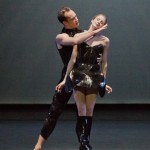
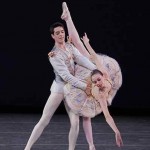
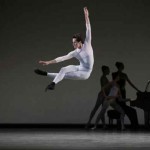
Morphoses/The Wheeldon Company dancers take part in a performance of Christopher Wheeldon's "Commedia" at the New York City Center in New York, Oct. 1, 2008. Photographer: Erin Baiano/Morphoses/The Wheeldon Company via Bloomberg News

Oct. 3 (Bloomberg) -- Morphoses/The Wheeldon Company is still a dance troupe in the making. At the New York City Center through Sunday, it features a cluster of international stars moonlighting to support Christopher Wheeldon's branching out on his own after seven years as resident choreographer of the New York City Ballet. Since forming his group, he has also benefited greatly from the institutional support of City Center and of London's Sadler's Wells Theatre.

The first of two programs contradicted Wheeldon's brashly expressed desire of ``making it new'' -- saying goodbye to Balanchine and all that. In his pre-curtain speech at opening night on Wednesday, he talked about looking to the past for the way to the future; his own recent ``Commedia,'' set to Stravinsky's familiar ``Pulcinella Suite,'' underscored this. Referring to the glory days of Diaghilev's Ballets Russes (which included Massine's ``Pulcinella'' in its repertory), it translates commedia dell'arte-style cavortings and romances into Wheeldon's own cool style, deliberately calling attention to its inventiveness. Its best feature is a love duet typical of this choreographer in its all too self-conscious charm.

The other new work on the bill was Morphoses's first independent commission, which one can only hope is not prophetic. Canadian Emily Molnar's ``Six Fold Illuminate,'' set to Steve Reich's ``Variations for Winds, Strings, and Keyboards,'' suggests that if ever a composer and choreographer were ill-matched, it is this pair.

Hypnotic Spooling

Instead of responding in kind to the music's hypnotic spooling out of delicately varied repetitions, Molnar has two women and four men endlessly showing us flesh being hauled around -- by its owner or partner -- as if it were heavy meat. In the two main duets, the battle of the sexes is rehashed with ever-deadening hostility and co-dependency.

Neither of these creations competes with -- or even complements -- Wheeldon's 2001 ``Polyphonia,'' which introduced the current program and was sveltely performed. Along with the 2002 ``Morphoses,'' these works -- both to Ligeti scores -- made the young choreographer's name. He hasn't topped them yet. Meanwhile, Frederick Ashton's sublime ``Monotones II'' got a sub-par rendition, while the ravishing central duet from that master's ``The Dream'' has been relegated to the second program.

Wheeldon's fame rests on the fact that no one in his generation could rival his suave practical skills in making a contemporary classical ballet. Given the fact that he absorbed and processed so intelligently lessons from the work of Ashton and Kenneth MacMillan in his early dance life with England's Royal Ballet, and George Balanchine and Jerome Robbins when he joined the New York City Ballet, admirers were willing to overlook a certain sameness in his style and its seeming lack of heart.

Now he has a rival in the Bolshoi Ballet's artistic director Alexei Ratmansky, who went through a decade of peripatetic alliances, learning about Western dance without sacrificing his Russian roots. His works (including ``Russian Seasons'' and ``Concerto DSCH,'' made for City Ballet) have been much appreciated in the U.S. for the very humanity that's missing in Wheeldon's.

After an awkward flirtation with City Ballet, Ratmansky recently accepted a five-year appointment as artist in residence with American Ballet Theatre. Perhaps the competition will benefit both choreographers. It will certainly be engaging for audiences.

Through Oct. 5 at 131 W. 55th St., Manhattan. Information: +1-212-581-1212; http://www.nycitycenter.org.

© 2008 Bloomberg L.P. All rights reserved. Reprinted with permission.

October 5, 2008 11:25 AM |
October 2, 2008

This article originally appeared in the Culture section of Bloomberg News on October 2, 2008.

Oct. 2 (Bloomberg) -- Bill T. Jones, most often given to raving and ranting about the world's downside, does a welcome, if ironic, about-face with ``A Quarreling Pair,'' featuring the gaiety, verve, and sometime vulgarity of vaudeville.

btj1.jpg

Tracy Ann Johnson plays two sisters, adventurous Rhoda, seen here, and timid Harriet, during a performance of Bill T. Jones's "A Quarreling Pair" at the Brooklyn Academy of Music's Next Wave Festival in New York, on Sept. 29, 2008. Photographer: Stephanie Berger/BAM via Bloomberg News

At the Brooklyn Academy of Music, where it inaugurates this year's Next Wave Festival, the show takes off from Jane Bowles's brief puppet play of the same title, written in the mid-1940s. Aging spinster sisters of conflicting temperaments, Bowles's Miss Harriet and Miss Rhoda are nevertheless inextricably bound, living together in emotional claustrophobia. Harriet is too timid to venture beyond querulous banal exchanges with Rhoda, who yearns to escape -- to live in a wider world and contribute to it -- but never can.

Typically, Jones provides an up-to-date, postmodern take on the circumstances. He begins, pointedly, by having one actress -- the magnetic Tracy Ann Johnson -- play both sisters. He lets Rhoda out of her prison but denies her a happy ending. Harboring a romantic instinct for wanting to help people and also fancying herself a jazz singer, Rhoda fails at both.

btj2.jpg

Dancers Antonio Brown, left, and Paul Matteson take part in a performance of Bill T. Jones's "A Quarreling Pair" at the Brooklyn Academy of Music's Next Wave Festival in New York on Sept. 29, 2008. Photographer: Stephanie Berger/BAM via Bloomberg News

She ruins her cabaret act by leaving her mobile phone on -- talking to the sister she left behind. She then manages to hook up with a sleazy Mexican vaudeville show, where an abusive drag queen co-opts her as a dresser and victim. Reduced to wandering the gray streets, she's rejected even by the suffering multitudes.

No Retreat, No Surrender

Nevertheless, Rhoda refuses to retreat to the bland, frustrating safety of home and sister. If degrading and discouraging adventures represent the real world, so be it.

As in much of Jones's work, the plotline is occasionally fuzzy, but the dancers of the Bill T. Jones/Arnie Zane Company, celebrating its 25th anniversary, are terrific -- swift, precise, balletic, jazzy and acrobatic at once. Jones's choreography for them is particularly memorable in the ``exotic'' showbiz acts, where the performers' shenanigans are etched in acid. It's less effective in the passages for the tired, poor and instinctively hostile masses. Jones's affection for characters intent on pushing life to extremes appears to be far stronger than his empathy with figures worthy of pity.

A theatrical multimedia man, Jones, is ably abetted throughout by Bjorn Amelan (set design), Liz Prince (costumes), Robert Wierzel (lighting), Janet Wong (video design) and a trio of musicians: Wynne Bennett, Christopher William Antonio Lancaster, and George Lewis Jr.

No Jones production lacks its thorny issues, which usually come in multiples. In ``A Quarreling Pair,'' Jones hints at the question of what makes any couple or group able to co-exist. He also wonders, if only in a whisper, if it's possible to improve the world and, if not, whether grace lies in trying anyway.

Best of all, though, he's asking loud and clear if performers -- often folks who like to sing, dance and cavort -- shouldn't occasionally be allowed to shed art's deeper and darker concerns and just let the good times roll. The answer to that last one is a heartfelt yes.

Through Oct. 4 at BAM's Howard Gilman Opera House, 30 Lafayette Ave., Brooklyn. Information: +1-718-636-4100; http://www.bam.org.

© 2008 Bloomberg L.P. All rights reserved. Reprinted with permission.

October 2, 2008 11:30 AM |
September 22, 2008

This article originally appeared in the Culture section of Bloomberg News on September 19, 2008.

Sept. 19 (Bloomberg) -- The most rewarding number in Wednesday's opening night of New York City Center's annual Fall for Dance marathon came last: a dozen of the National Ballet of Canada's men magnificently performing Jiri Kylian's ``Soldiers' Mass.'' The dance was composed in 1980; its message, of the men's fear, courage, patriotism, bonding and hope so certain to be defeated, couldn't be more timely.

Beautiful, too, though not so understandable, was the world premiere of Thailand's Pichet Klunchun Dance Company in ``Chui Chai'' (``Transformation''). A handful of women create a golden glow in their elaborate robes, elegantly topped by headdresses with quivering spires. They manipulate their wrists, fingers and feet in the eloquent, grotesque style required by their tradition. A sole man, dressed in workaday black T-shirt and trousers, joins them: a wistful acolyte. The point remains unclear (other than the presenters' impulse to go global).

The curtain raiser was Shen Wei Dance Arts in excerpts from his 2005 ``Map.'' His work, which has many fans (I'm not one) tends to be more pictorial than ``dancey,'' often in slow-motion and self-consciously gorgeous. Though ``Map'' features swifter, more forceful action, I found it no more engaging than his other pieces.

It sets its 14 dancers in the pretentious backdrop's futuristic landscape. They transform from motionless blobs to triumphantly erect figures, then to agitated moves -- endlessly repetitious and void of choreographic interest -- in strict patterns that threaten to go on forever.

Keigwin + Company presented ``Fire,'' excerpted from Larry Keigwin's recent ``Elements.'' I cringed at its grade-school humor; the audience loved it.

Must-See Hula

There is plenty to look forward to on the other programs in Fall for Dance, one of the city's great culture bargains (every seat is $10 at every performance). First among the coming attractions that are Must Sees for me is ``The Gentlemen of Halau Na Kamalei.'' My knowledge of the hula is pathetically limited to the National Geographics of my childhood. I've never seen the emblematic Hawaiian dance done live and never even knew that men did it as well as women. Now's my chance.

With the San Francisco Ballet performing ``In the Night,'' Fall for Dance will offer a welcome opportunity to see how companies other than New York City Ballet dance works created by Jerome Robbins.

Suzanne Farrell Ballet, which, through its Balanchine Preservation Initiative, often revives Balanchine works long thought lost, will dance ``Pithoprakta'' to thorny music by the Greek composer Iannis Xenakis. The title role of this duet was created on Farrell in 1968; who but she, a superb teacher, should give it its afterlife?

And then there's the bicoastal contemporary choreographer Kate Weare, from whom great things are expected. Typically, she deals with intimate personal relationships, coupling fierce movement with subtle feeling. What she and her company make of them in ``The Light Has Not the Arms to Carry Us'' remains to be seen. Keep your eye on the redhead, Leslie Kraus, this year's Fall for Dance poster girl.

Through Sept. 27 at 131 W. 55th St. Information: +1-212-581-1212; http://www.nycitycenter.org.

© 2008 Bloomberg L.P. All rights reserved. Reprinted with permission.

September 22, 2008 8:56 PM |
September 19, 2008

This article originally appeared in the Culture section of Bloomberg News on September 16, 2008.

sfb.jpg

Two San Francisco Ballet dancers perform during a routine. Photographer: Erik Tomasson/New York City Center via Bloomberg News


Sept. 16 (Bloomberg) -- Ten dollars for any seat in the house at New York City Center? That admission fee to the Fall for Dance Festival, Sept. 17 to 27, may be the biggest bargain of the dance season about to launch. Now in its fifth year, the series operates on the something-for-everyone principle. Each of its 10 performances offers a look at four or five different dance styles from ballet to modern, from America's tap to India's Odissi to Hawaii's hula (with an all-male company). Veteran dance fans as well as newbies flock to the shows.

Plain old classical ballet -- ominously pronounced as ``over'' by advocates of the new and edgy -- still has its ardent fans, if largely among the older and more traditionalist audience.

American Ballet Theatre holds forth at City Center Oct. 21 to Nov. 2, its engagement highlighted by an Oct. 31 tribute to Antony Tudor, who was the all-time master at turning feeling into flesh. The company's roster of male stars continues to astonish.

The New York City Ballet opens with a gala repertory evening Nov. 28, then segues into the economically essential five weeks of ``The Nutcracker,'' which George Balanchine thankfully infused with poetry and food for thought. Does one dare go without a child? Yes, and the experience may be enlightening.

Christopher Wheeldon, until recently the City Ballet's resident choreographer, is first among the dance-makers determined to update classical ballet rather than abandon it. He has recently branched out with his own group, Morphoses/The Wheeldon Company -- an ambitious name for a newcomer still in the pickup stage -- which will play at City Center Oct. 1 to 5.

Real People

America's oldest professional classical company, the San Francisco Ballet, has become a national and international contender under artistic director Helgi Tomasson. The troupe will be at City Center Oct. 10 to 18, with no fewer than three different repertory programs. The choreographers range from Balanchine, with whom Tomasson danced so unforgettably, through Tomasson himself to Mark Morris, who makes dancers look like real people, and the take-no-prisoners Jorma Elo.

Among the talents representing the 20th-century evolution of modern dance will be Lar Lubovitch, who is celebrating the 40th anniversary of his troupe, and the inimitable Garth Fagan (``The Lion King''). They couldn't be more different. Lubovitch is a purist with a romantic heart. Early works of his, set to scores by Steve Reich and Philip Glass, will be shown at Dance Theater Workshop, Oct. 30 to Oct. 4; a program emphasizing later creations, at City Center Nov. 5 to 9.

Contrasting Genres

Fagan, at the Joyce Theater Nov. 3 to 9, is an earthier artist, whose semi-balletic concert-dance impulses are infused with contrasting genres, like jazz and Afro-Caribbean. The long, lean and gorgeous Norwood Pennewell is Fagan's perennial muse, and the other dancers, animating role after role, seem to embody a fantasy family that exists in the mind's eye of the choreographer.

Post-modern work (by the anti-Establishment folks from Merce Cunningham onward) will abound, in wildly different guises. Anne Teresa De Keersmaeker favors the intellectual and minimalist, but she can make endless repetition with only the smallest variations as exciting as a brisk fall wind sweeping through town. Her program of works to Reich music is at the Brooklyn Academy of Music's (BAM) Howard Gilman Opera House Oct. 22 to 25.

Mixed Media

Eiko & Koma, at the Joyce Oct. 27 to Nov. 2, create eerie, slow-motion pieces that, like Butoh, are haunting reminders of death. Their latest effort, the evening-length ``Hunger,'' commissioned by the Joyce to celebrate its own 25th year, involves a pair of Cambodian painters in their hypnotic proceedings.

These days the ever more popular Bill T. Jones expresses his rage at injustice not only in words and movement, but also with a whole visual and musical cacophony. This mixed media for the new age should be evident in ``A Quarreling Pair'' at the BAM Howard Gilman Opera House, Sept. 30 to Oct. 4.

Be there.

New York City Center is 131 W. 55th St. Information: +1-212-581-1212; http://www.nycitycenter.org.

Dance Theater Workshop is at 219 W. 19th St. Information: +1-212-924-0077; http://www.dancetheaterworkshop.org.

The Joyce Theater is at 175 Eighth Ave. Information: +1-212-691-9740; http://www.joyce.org.

BAM's Howard Gilman Opera House is at 30 Lafayette Ave., Brooklyn. Information: +1-718-634-4100; http://www.bam.org.

© 2008 Bloomberg L.P. All rights reserved. Reprinted with permission.

September 19, 2008 9:22 AM |
September 14, 2008

No elegance is possible without perfume. -- Gabrielle ("Coco") Chanel


When I arrive at my friend Renée's house in Paris, she is knitting a small fleecy white garment. She embraces me, holds it up, and says, "It's for your grandchild-to-be." I'd written her that my first grand was on its way.

"You will be a wonderful grandmother," she declares.

Frankly, I see no reason why I shouldn't be. I adore children, always have. Playing and adventuring with them is one of my top three delights, and they respond to me in kind.

"And your grandchildren will remember you forever," Renée continues.

Well, now that's something else entirely. I see no particular reason why anyone should "remember me forever," least of all the young, who are typically absorbed in their own affairs. So I ask, "Why is that?"

"Parce-que vous êtes parfumée," she replies with wisdom-of-the-world assurance. (Because you wear perfume.)

Despite her use of the formal "you" in her native French, an old-fashioned indication of respect that she employs even with her beloved daughter-in-law, Renée, once my professor during her New York years, has become one of my most cherished friends--profoundly cultivated, innately elegant, and, far more important, a mistress of empathy.

As for the wearing of perfume, I come by it rightly. My mother always wore a fragrance, most often Ann Haviland's spicy "Carnation," while her elder sister, for whom my daughter is named (so you can imagine how I adored her), favored "Wood Violet," which echoed her sweet, self-effacing personality.

When I was about fourteen, growing up in deep, dark Brooklyn, my mother started taking me with her to the discount-perfume shop she patronized and allowing me to chose a scent for myself. I was finicky to the point of absurdity. At one session, the saleswoman, having proffered countless samples, all in vain, said, "Tell me, my dear, exactly what would you like your fragrance to smell like?"

"Soap," I answered on the instant, then immediately corrected myself. "I want it to smell as if I actually--naturally--smelled like that." (Our soap at home was Ivory. It did have a nice, fresh scent and, what's more, it floated.) I can't recall what we finally settled on that day. Fairly soon, though, rebounding from my "natural" phase, I moved into the realm of "Calèche," "Cabochard," "Antilope"--all three the antithesis of girlish, a mode I had come to despise.

In my later teen years, when I wore my clothes black, my long hair loose--Veronica Lake-style, my mother called it--and took a full ten minutes to layer my lashes with black French cake mascara, I wore Lanvin's "Arpège," it being so much more sophisticated, I still think, than "Chanel No. 5," synonymous with Gallic chic in the mind of the general public.

I can't believe I remember all this--I who have such indifferent recall--except for the things that constituted the pillars of my imagination: for instance, the names of all the dancers in the New York City Ballet when I first saw the company.

At college, inspired by Renée, with whom I studied medieval French literature, I wore Lancôme's "Joyeux Été," until the firm discontinued it. For me, that move was little short of tragic--I was far less disconcerted by the loss of a boyfriend that coincided with it. Eventually, I compromised for a while with the same house's "Magie Noire," but it wasn't it, and when a thing isn't it, it might as well not exist. For me, there's no such thing as a Mr. Almost Right in the realm of scent.

Just before and after my marriage, I wore Worth's "Je Reviens" (which used to be colored blue and stained your clothes, if you weren't careful). The name means "I will return." "Is that a promise or a threat?" my eventual husband used to joke.

And then, once I had begun writing about dancing, I discovered the old Guerlain fragrances. My favorite was "Mitsouko," not least because it had been Diaghilev's scent. Now favored by both men and women, it was introduced to me by my fellow dance writer Sally Banes and worn for decades by Balanchine's right-hand-woman, Barbara Horgan. I abandoned it finally when the formula seemed to become more synthetic or something that made it not quite true to itself.

After the eclipse of Guerlain, I practiced a kind of serial monogamy, returning to old favorites for months, even years, at a time. More successfully--since the old scents or I had changed and thus lost our affinity with each other--I discovered new creations. Some later-breaking favorites: The original Vera Wang fragrance that had no name except the designer's. "Armani for Women," a brash (and, in my case, deceptive) statement of cosmopolitan self-assurance. Issey Miyaki's "L'eau d'Issey" (back to the pure and subtle realm of floating soap). Calvin Klein's "Eternity" as well as the same firm's "Truth."

I haven't yet succumbed to the new fad for scents that evoke herbs, fruits, even sweets ( and exotic combinations thereof), concocted to gratify our time's raging lust for novelty. Are they merely perverse or perhaps the next step--after the "Poison" phase--in the feminists' repudiation of the innocent florals? After all, a Woman Warrior can hardly go around town (or to bed) smelling like a rose. Or so I assumed until, I was tempted recently by, of all things, Bulgari's tender, shy Rose Essentielle.

I don't know why people complain about the long waits at the airport nowadays. This limbo of ostensibly lost hours provides the perfect occasion to wile away time guiltlessly by trying out new fragrances--that is to say, new states of being. When you're surrounded by a just-discovered evocative aura, anything could happen. Anything.

© 2008 Tobi Tobias

September 14, 2008 12:21 PM |

About

Seeing Things began life as my ArtsJournal blog, maintained from 2003 through 2005. In 2006 it became the viewing site for the writing on dance that I continue to do elsewhere . . .

Tobi Tobias lives in New York City, where she writes about dance and other things worth looking at.

My Books I have written "Obsessed by Dress," a meditation on fashion or--more broadly--clothes, and over two dozen books for children. You can find out more about these diversions from journalism by clicking on (what else?)

Contact me Click here to send me an email...

Newsletter Want to be notified when I post a new review? Click here...

Archives

Archives: 402 entries and counting

Other Words


. . . and while I know a woman who learned Greek at ninety there are nevertheless some skills, like ballet dancing and gum chewing, which can only be mastered by the very young.
-- Jean Kerr, Penny Candy

Now that my hair is white, and my years of life ahead are growing fewer, I think that the pains I have taken over dancing have not really been pains, and I must study harder, much harder.
-- Onoe Kikugoro VI (familiarly called Rokudaime), in Ben Bruce Blakeney, "Rokudaime," Contemporary Japan, 18

When people grow old they must be dull. Dancing can't go on for ever.
-- Anthony Trollope, Can You Forgive Her?

When you do dance, I wish you / A wave o' the sea, that you might ever do / Nothing but that.
-- William Shakespeare, The Winter's Tale

Sitelines

ARTSJOURNAL

ARTS & LETTERS DAILY

BALLET.CO

BALLERINA GALLERY

THE DANCE INSIDER

DANCEVIEW TIMES

FOOTNOTES

GREAT DANCE WEBLOG

THE WINGER

The RÉUNION DES MUSÉES NATIONAUX (The National Museum Association's Photographic Agency) offers a photographic catalogue of some 200,00 holdings of French museums. It can be searched by artist, country, period, subject, and so on. You can make a personal album of your favorites on the site. New York's Metropolitan Museum of Art and D.C.'s National Gallery have similar services, but the French one is the most ambitious and extensive. Text in English as well as French.

AddALL is an ultimate umbrella for finding used and out of print books online. It doesn't have the atmosphere of Foyle's, Powell's, or even the Strand, but it will give you every opportunity to need yet another bookcase.

PROJECT GUTENBERG More books. No bookcase required. Over 6000 free electronic texts.

CALLIGRAPHY LESSONS ONLINE Learn the italic hand and make yourself legible. Don't miss the animation.

Color charts of HERBIN INKS. If you have to ask, you'll never know.

THE NEW YORK TIMES Because it's there.

Find recent content on the main index or look in the archives to find all content.

AJ Ads

Introducing
AJ Arts Blog Ads

Now you can reach the most discerning arts blog readers on the internet. Target individual blogs or topics in the ArtsJournal ad network.

Advertise Here

AJ Blogs

AJBlogCentral | rss

culture
About Last Night
Terry Teachout on the arts in New York City
Artful Manager
Andrew Taylor on the business of arts & culture
blog riley
rock culture approximately
CultureGulf
Rebuilding Gulf Culture after Katrina
Dewey21C
Richard Kessler on arts education
diacritical
Douglas McLennan's blog
Flyover
Art from the American Outback
Life's a Pitch
For immediate release: the arts are marketable
Mind the Gap
No genre is the new genre
Rockwell Matters
John Rockwell on the arts
Straight Up |
Jan Herman - arts, media & culture with 'tude

dance
Foot in Mouth
Apollinaire Scherr talks about dance
Seeing Things
Tobi Tobias on dance et al...

jazz
Jazz Beyond Jazz
Howard Mandel's freelance Urban Improvisation
ListenGood
Focus on New Orleans. Jazz and Other Sounds
Rifftides
Doug Ramsey on Jazz and other matters...

media
Out There
Jeff Weinstein's Cultural Mixology
Serious Popcorn
Martha Bayles on Film...

classical music
The Future of Classical Music?
Greg Sandow performs a book-in-progress
On the Record
Exploring Orchestras w/ Henry Fogel
Overflow
Harvey Sachs on music, and various digressions
PostClassic
Kyle Gann on music after the fact
Sandow
Greg Sandow on the future of Classical Music
Slipped Disc
Norman Lebrecht on Shifting Sound Worlds

publishing
book/daddy
Jerome Weeks on Books
Quick Study
Scott McLemee on books, ideas & trash-culture ephemera

theatre
Drama Queen
Wendy Rosenfield: covering drama, onstage and off
lies like truth
Chloe Veltman on how culture will save the world
Stage Write
Elizabeth Zimmer on time-based art forms

visual
Aesthetic Grounds
Public Art, Public Space
Artopia
John Perreault's art diary
CultureGrrl
Lee Rosenbaum's Cultural Commentary
Modern Art Notes
Tyler Green's modern & contemporary art blog
Creative Commons License
This weblog is licensed under a Creative Commons License.